Showing posts with label Johannesburg sightseeing. Show all posts

Monday, 2 September 2013

Joburg City Festival 2013

(Click on photos to view gallery)

The JCTA is a voluntary organisation representing businesses and organisations who have a stake in tourism in downtown Joburg. The organisation aims to promote the many attractions of the Joburg inner-city to residents and visitors, who still don't quite get what newbies in town like me are already so excited about. To get the ball moving, in the last week of August the JCTA organised the first ever Joburg City Festival. It was a week full of special events and parties, walking tours, concerts and exhibits, street football and ballet, poetry, fashion, cookery lessons and much more.


The JCTA headquarters are in the random turret building on the right of this picture

I certainly didn't get to as many of the events as I wanted to, but what I did do was discover a lot more about the inner-city and its different areas. After all this exploration of the CBD's various 'hoods I am starting to feel like quite the confident downtown Joburger...even if I am really just an expat who lives in the Northern Suburbs.


The Fashion District


One of the coolest venues during the week was the Fashion Kapitol which is located deep in the 26 block expanse of the 'fashion district'. The Fashion Kapitol is an initiative by a local fashion institute to inject new life into this historic fabrics and clothing area. They have an open-air runway where they stage fashion shows, retail space for cool little boutiques and a nice cafe called The Fashion Shack located inside one of the oldest surviving buildings in the area.

There were lots of tuk tuks about to take festival goers to the different venues

I kept turning up here intent on catching one of the fashion shows which had names like Freaky Friday, Trendy Thursday and Magical Monday, but somehow I kept missing them. Even though I never saw one of the big fashion events, I did still get to pretend I was The Satorialist wandering around and assessing the local style. Personally I think it's not always what people here are wearing, more how they are wearing it - Joburgers have real poise and tons of attitude, they can make a lot of getups look very sharp and cool. I love the colours of the shops around this area too. 


Kerk Street Market


The Kerk Street Market is one of my favourite markets in the CBD. It has great fruit and veggies, as well as the usual football shirts, trainers, gadgets etc. There are many more hectic markets in the city, yet somehow Kerk Street manages to remain simultaneously calm but also full of life. Apparently the hair braiders at the Kerk Street Market are some of the best on the whole continent. They don't have fancy salons, just chairs on the street and they are never short of custom.


On the last day of the festival in Kerk Street there was an event called 'Claim Your City'. A sound system was set-up and local musicians played throughout the day. I dropped by and caught a male soul group giving it everything - they were brilliant.


Gandhi Square Street Football


On Gandhi Square, the transport hub for those using the Metro Bus, there was a 'street football' championship going on all week. Street Football here meant five-a-side and the teams were impressively well organised and played really high standard football. The eventual winners were the Penthouse Scorpions who quite simply outclassed everyone else. They won a new matching team kit and kit bags, as well as 5,000 Rand - not bad for a bit of street footie!


Braamfontein and Critical Mass


Braamfontein is one of the most fashionable parts of downtown Joburg. Full of students there's no shortage of creative ideas, pumping bars and cool coffee shops. I spent quite a lot of the week here, sipping my way through a list of the area's top cafes (more on that later), making my first trip out to the fascinating Constitution Hill and enjoying my first meet up with the fun crowd known as the Jozi Bloggers (also more on that later).

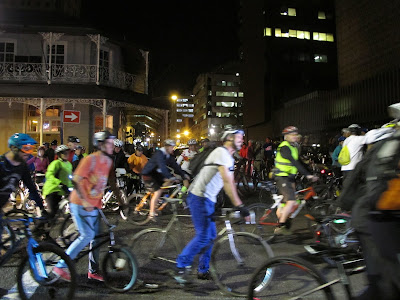
I sadly did not take part (this time) in the mass cycling event Critical Mass which left from Braamfontein on Friday night to zoom around the city centre. I did however hover around and do that blogger thing of taking pictures of the dudes while they were preparing to leave. There were all kinds of people at this event, hipsters, old folks, serious cyclists, young kids, yuppies, students, bloggers (probably)...it's pretty cool how the love of travelling on two wheels unites different folks and I think the whole Critical Mass ethos really matches well with the mission of the Joburg City Festival. Really looking forward to the next edition.


Thursday, 11 July 2013

11.07.2013 Walking the Joburg CBD - Marshalltown

I've started to develop a bit of an addiction - namely spending the day wondering aimlessly around the Johannesburg CBD (Central Business District). In a city which has some pretty soulless malls and anonymous suburbs and a shamefully large amount of informal housing and derelict buildings, the CBD shines out for me as a place filled with history, interesting architecture, people from all walks of life. It feels like somewhere which is certainly on the up and in a palpable state of revival. Downtown for me is real city life.

View of the CBD from a bridge crossing the railway tracks

In our first week here I ventured out on my lonesome to explore the CBD and I actually landed in Braamfontein, mistakenly thinking I was in the heart of downtown Joburg. I can't lie, I was feeling kinda nervous. Everything at that time made me nervous. For the first time in my life I truly stood out as a foreigner and quite frankly the whole new continent thing was giving me some serious culture shock. In reality Braamfontein, just over the railway tracks from the CBD, is a really fun student part of the city, which has all of the most happening bars, lots of street life and some seriously hipster cafes. Back then having landed from Europe in the sterile Sandton bubble, Braamfontein's graffiti, rubbish, chicken shops, busy pavements, high density housing and lack of white people were an amazement for me - it was literally another city.

While I love Braamfontein for its great bars, cafes and nightlife (which actually kicks off at the weekend before it has even passed 6pm!), the CBD is still the heart of this city for me. Rich in variety and architectural splendour it has so much to see.

One of the most tourist friendly and prosperous parts of the CBD to walk around is Marshalltown, an area where you can really glimpse the former and present wealth of the city.

Chancellor House


This is the building where Nelson Mandela and Oliver Tambo had their legal practice and I wrote about it in a previous post so I am not going to go into details again. It is just a few blocks away from Diagonal Street where they sell a lot of blankets, heaters (I presume there will be fans and hats here in summer?) and other household stuff and interestingly you can also find a couple of Muti shops selling freaky things for use in traditional medicine and other juju stuff.


A Muti shop

Main Street and the chamber of mines


A short walk from the courts is the pedestrianised Main Street which has the lavish headquarters of numerous major mining companies such as BHP Billiton and AngloAmerican Gold. Many of the grand buildings here have facades with beautiful carvings relating to the gold rush and statues inspired by South Africa's magnificent wildlife. There are also some particularly nice pieces of public art, such as this statue of leaping springboks.


Facade at BHP Billiton
Main street is also peppered with relics from the mining industry such as old trains, stamp mills and pumps. It was from literally right under these streets that the first gold was mined a mere 130 years ago, leading to the swift creation of one of Africa's biggest cities. Main Street has many nice cafes frequented by local office workers (hence they are often closed on weekends) and even has a Woolworths Food (the posh South African supermarket). In nearby Anderson Street you can also find some of the nicest hotels in the city centre such as the Reef Hotel and the Mapungbuwe.

Random mining stuff

Library Square Gardens


A few blocks north of Main Street this square is another example of the successful restoration of beautiful historic downtown buildings. This is an area which was one of the very first to be developed in the city during the early gold rush years. The beautiful library at the heart of the square has recently been restored and is well worth checking out. With a large high school nearby the square is often filled with kids hanging out on their lunch breaks or playing while waiting for the bus. Looking over it is the Guildhall Pub, the oldest in Johannesburg and a great (and yes, safe) boozer.


The Guildhall Pub

Corner Fox Street and Loveday Street


A large part of Fox Street (running parallel to Main) is also now pedestrianised and has some big offices on it. It also has some amazing old buildings kept in very nice condition such as the impressive Old Standard Bank of South Africa building. Nearby you can also find the Post Office building (victim of fire a few years ago, awaiting restoration) and some other elegant civic buildings.

This could easily be somewhere in Europe...
The old Post Office

There are two very nice cafes here worth looking out for. Ma Bertha's -a very friendly new cafe on Loveday where you can get a huge plate of steaming stew and pap for 40 Rand. They even have tables and chairs right on the pavement in true European cafe culture style (i.e not roped off, but literally right in the middle of the pavement). The other is the much older Pinos, an Italian cafe with genuine Italian coffee, a very faithful clientele and a toilet which you have to be escorted through the kitchens to reach. It gets really busy here and is a very authentic recreation of an atypical Italian coffee bar.

Pino's

Gandhi Square


My strolls downtown often tend to start or finish here as this is the terminus for the Metrobus. Minibus taxi are still much more popular than the Metrobus as they are more reliable and take more complex routes - with Metrobus you can be waiting a long time or getting dropped really far from your home. But, that said I still enjoy riding the Metrobus back up north as they are double decker so you get a great view as you ride home.

Gandhi Square is of course named after the great Indian leader who worked as a lawyer in Johannesburg for many years. He has a statue on the square, but it is pretty small, blink and you might miss it. It shows Gandhi in his youthful lawyer years in court robes with some important looking papers.

Gandhi's statue
Back in the early 1990s Gandhi Square was a bit of a no-go area, despite being the main bus terminus for the city. There was a lot of trouble with crime and drugs, the lighting and policing was poor and people were constantly getting robbed here. Not so today however. The square is a hub of activity surrounded by office, shops, cafes and bars. It is very safe and is well looked after. It is also sustainable offering affordable business, retail and rental opportunities to the people who visit downtown the most. Much of the credit has to go to local entrepreneur Gerald Olitzki who worked hard to redevelop the area when anyone else with money had given up and fled to Sandton. You can read about him in this great article from 2010 by the Globe and Mail.

Gandhi Square
I think this huge banner on Gandhi Square pretty much sums up my feelings about Joburg's revival.

Tuesday, 25 June 2013

25.06.2013 Nelson Mandela - the Shadow Boxer

With the father of the nation and one of the greatest leaders of the 20th Century now critically ill in hospital, I thought this might the right time to write something about Nelson Mandela's time in Johannesburg.


Madiba moved to Johannesburg in 1941 where he first found work as a night watchman at a local mine. He then moved to the Alexandra township and got a job in downtown Johannesburg working as a clerk at a sympathetic Jewish lawyer's firm. The building (just off Library Gardens Square on Harrison Street) housing the firm is now called the Nelson Mandela Building and has a school and various offices in it.

After completing his BA degree and embarking on a law degree at Wits University (which he sadly was not allowed to complete), Mandela and his friend Oliver Tambo opened a legal practice for black South Africans in downtown Johannesburg opposite the Magistrates Courts.

Chancellor House where Mandela and Tambo had their legal practice
As the only black lawyers working in Johannesburg they dealt with a huge workload and the offices were constantly filled with people. As arguably one of the most important places in modern South Africa's history it is now finally being recognised as the historical landmark that it is and is going to be turned into a museum. For the moment there are exhibitions in the windows which explain what Tambo and Mandela were doing here and how. Amazingly as recently as four years ago the building was half-derelict and occupied by squatters.


The corner offices face the magistrates courts where a striking new monument to Mandela was recently erected. It is based on a photograph taken of the young Mandela shadow boxing on a nearby inner-city roof. Boxing was very important to Madiba, it kept him fit and focused, he admired the self-discipline and strength it involved and under it all of course boxing was egalitarian - the colour of the opponent is irrelevant in a fight. Underneath the monument is a quote from Long Walk to Freedom about boxing.

The original photo on which the monument is based
"In the ring, rank, age, colour, and wealth are irrelevant."

As a seriously ill and frail 94 year old man, it is sometimes difficult to look back and imagine how Mandela was in his youth - especially given that most of the world only caught sight of him once he was released from prison and had already dramatically aged. Therefore this monument was a very smart commission. It shows Mandela as a fighter, as strong, focused, hands on and of course most of all young. It's striking and inspiring and I hope will become a place where people can remember the great things which he achieved and how hard the struggle was, long after Madiba is gone from our lives.

Thursday, 16 May 2013

05.2013 May Day at Zoo Lake

To mark the mid-week May 1st holiday earlier this month, we decided to head down to Zoo Lake. There are lots of pretty parks in Johannesburg, some of which have incredible views of the inner-city skyline (as in the picture on the banner of this blog). Zoo Lake does not have such views, but it is still currently my absolute favourite Joburg park.

The lake at Zoo Lake. There's a zoo here too...somewhere

This is a real people's park - you can lounge around on the grass, play sports, have a picnic and of course fire up a braai and all the while there are guys driving around on mopeds with ice-cream vending sidecars. There are no strict 'no ball games, no barbecues, do not walk on the grass' etc type rules. The only things not allowed are ghetto blasters, stereo sound systems and the like, a rule which I totally agree with and which I think most of the people visiting the park would agree on too.

Ice-cream sidecar
Overall though it's the cosmopolitan mix up of Zoo Lake that makes it so special. You can find all kinds of people here, it's truly a rainbow park. Within the twenty metre radius of our lounging spot on the grass there was a huge Arab family having an elaborate picnic and playing a hotly contested game of cricket, a group of trendy black students enjoying a highly animated game of sherades, a very loved up old white couple canoodling and a big multi-racial white, Indian, black, Asian kick around with a football.


It's a shame that Winter Is Coming and there won't be so much relaxing in the park going on in the next few months, but I'll bet as soon as spring arrives this place will be packed again - can't wait!


How I got there: We came here by car from Bolton Road (next to the Rosebank Mall). It is down a hill and then some, so if walking from Rosebank, you'd need to walk about 40mins plus.

Tuesday, 7 May 2013

04.2013 The Carlton Centre - Roof of Africa

Right in the centre of downtown Johannesburg stands Africa’s tallest building, the foreboding 222 metre high Carlton Centre. For 15R (about 1 pound) you can ride the lifts up to the 50th floor to the Roof of Africa viewing level (the ticket office is in the lower part of the shopping centre in the building’s base - just ask someone, it’s not obvious where it is). From way up here on a clear day you can see 30km or more out over the Gauteng area and get a feel for the incredible number of skyscrapers in downtown Joburg, and for the huge size of the indistinct sprawl of green suburbs which spreads out from it. The view of all the lights at night must be incredible, but alas nobody visits downtown after dark and even if they did it wouldn’t be open anyway (closes at 18:00). 


Back in the 1970s this building and the huge (now closed) Carlton hotel next door were the most prestigious in the city, full of imposing gold-rush city wealth and success – and even a sky-high ice-rink of all things. I like how the local writer and novelist Christopher Hope put it;

‘We boasted about the Carlton - it was said to be the greatest concrete erection in the world - another triumph attributed to those razzle-dazzle boys who ran the town…See how the knee bends, the head bows at the magical invocation of true, ingot-dripping, bullion-loaded dazzle.’


Nowadays, the building looks dated and a bit skuzzy at the edges, while the hotel next door is empty and closed. The state monopoly Transnet (which runs all of South Africa’s freight movement), has the Carlton Centre as its HQ, while other floors are occupied by civil servants. Meanwhile in the basement levels a lively mall has sprung up and the occasional tourist like yours truly makes the journey 50 floors up to join a handful of others in gazing out over this strange and intriguing city.


How I got there: We walked to the Carlton Centre from Park Station following the grid system down Rissik Street and then along Commissioner Street. That’s a 25plus minute walk at African pace, but you do get a feel for the irresistible buzz of downtown street life along the way. Alternatively you can also take the lazy slow route and hop on the Rea Vaya bus from in front of Park Station (be aware that buses do not run regularly at weekends).

04.2013 - Graffiti - Maboneng and Troyeville

City of Gold Festival 2013

Johannesburg recently held a week long ‘graffiti festival’ called the City of Gold Festival. As an art form, graffiti seems the kind of thing which doesn’t really suit itself well to something formal like a festival. For that reason the largest part of the event took the form of film screenings and talks. As for the actual on-street graffiti side of things a few huge walls (this city is full of huge walls) were designated as massive canvases for local street artists and a few international visitors to make their mark.

The best way to find your way around these ‘exhibits’ of course is on foot and with a guide who knows where this stuff actually is. The fantastic girls at Past Experiences were organising a graffiti tour and for 120R and I was very excited to join my first Joburg walking tour.

Maboneng

Maboneng
The tour started at a tiny little street cafĂ© called Uncle Merv’s in a very attractive inner-city area of about 4 blocks called Maboneng. The Maboneng area is all owned by one guy who bought up a bunch of old warehouse buildings and then was determined to get the city’s cultural movers and shakers in and get gentrifying. If you think about it too much it’s a strange kind of place, but all-in-all it's still instantly attractive and a generally hip part of town. Packed with stylish, characterful cafes and bars, friendly faces and all very clean and very safe - it's a good idea well-executed. 

3 blocks from Uncle Merv's
The odd aspect (for me) is the contrast between the blocks around Maboneng and the area itself. There are no big walls or gates, but somehow the slightly rundown and gritty air of the rest of downtown is conspicuously absent. On the same street you’ve got some very fashionable warehouse flats and slick cafes and literally just around the corner it’s all derelict buildings and overflowing rubbish bins. Somehow there’s still no in-between ground. All extremely high contrast. I guess that’s a Johannesburg thing.

Uncle Merv's

This crazy eye is made from pebbles
Love monsters

 Troyeville

From Maboneng we began our walk straight up Commissioner Street into an area called Troyeville. Along the way we saw some murals which had been painted during a previous street art festival, controversially not by locals but by famous international street artists. Controversy aside, I still thought some of them were really interesting.


Troyeville is historically an area where new migrants to the city first set themselves up before finding their way into other parts of town and is one of the oldest districts in Johannesburg. Sadly over the years serious neglect has fallen upon the area’s historic houses. According to our guides, the locals actually really like what the city’s street artists are doing with their walls - it adds colour and life to the concrete jungle and brings art into their lives. The artists for their part of course love that Troyeville has embraced what they are doing and appreciates their art and many artists have actually decided to move into the area themselves. Win, win situation.


At one point, walking down one of the quiet pedestrianised backstreets of the area, we came across an awesome piece which had just been done by a group from Reunion Island as part of the festival. We bumped into 3 guys there who live in the building and they all agreed that it was pretty darn cool (see below).


Artists in action

Back over towards the Maboneng area and heading for the end of our tour we were lucky to find some of the City of Gold artists in action. Four artists, three of them South African and one from the UK, had been given a huge wall to do with as they wished. Their works didn’t really correspond with each other in any particular way, although according to the British guy he had been told that the local guys like to use bright colours so had thought through his own palette accordingly. Watching people paint is admittedly not hugely interesting, but seeing how they manage the scale of what they are working with was definitely impressive.


Now I have to admit that I was first more attracted to this tour because I thought it would help me with my street confidence to be shown around the areas around the CBD which I would be too afraid to venture into by myself as a newbie. I also thought, 'ah I'd prefer to be taking my camera out in company' (safety in numbers and all that). The graffiti and its purpose was something I hadn't really considered too much.

However, seeing the reaction of locals to the artists on their streets and witnessing how huge pieces of colourful graffiti in public spaces (rather than on the side of railway lines or on motorway flyovers) are actually embraced by the people who live there…well it put a new spin on things for me. What these guys are doing is not just marking their space and having fun. In this city of high walls and peeling paint, this form of street art is genuinely contributing to the better enjoyment of the inner-city for its residents.
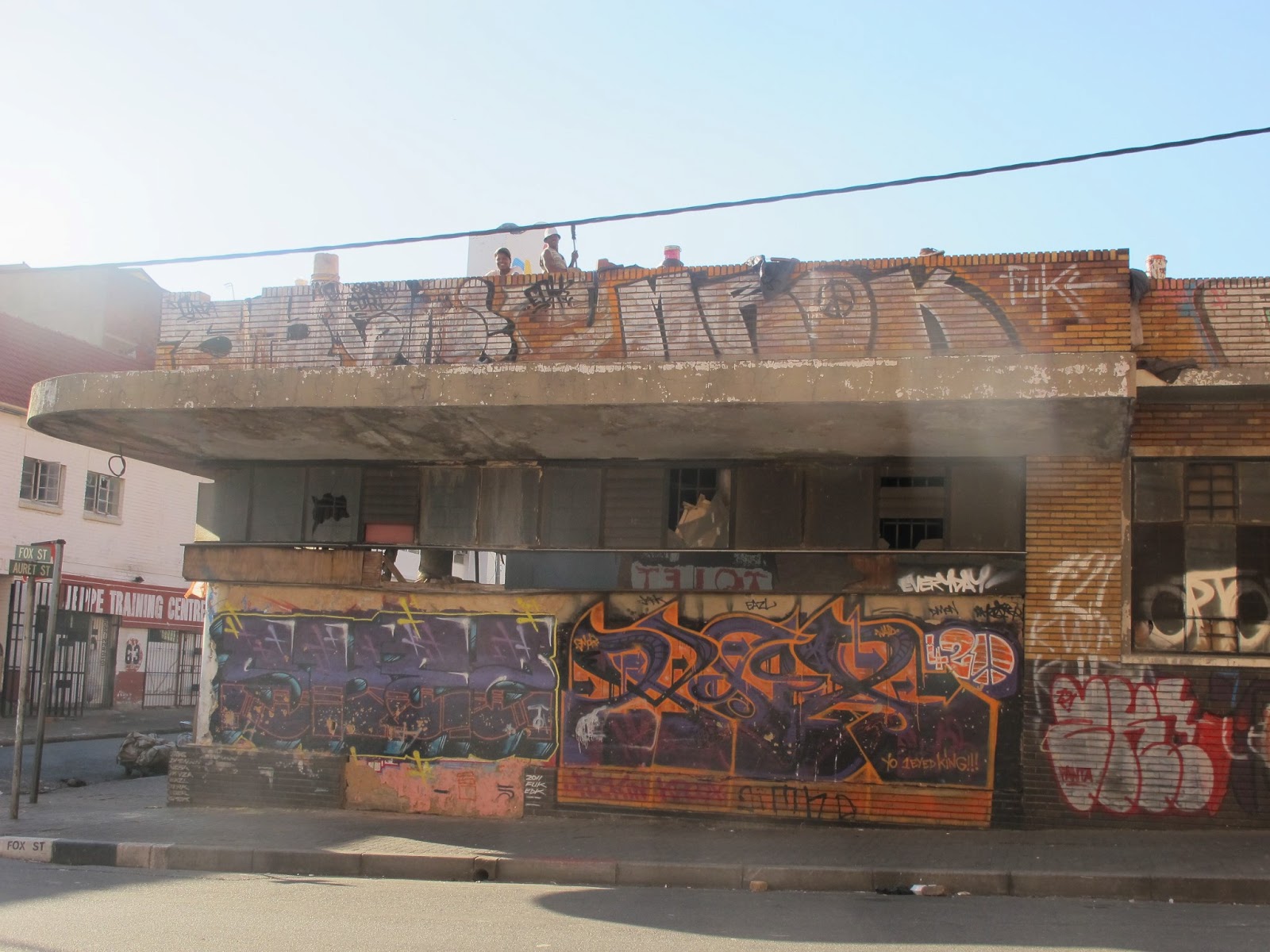
 

Waiting by Faith 47 (bottom left corner)
HOW I GOT THERE: On the way there I took the Rea Vaya circle route (C3) bus from outside Park Station to the Carlton Centre and walked about 6/7 blocks (20mins walk) straight down Commisioner Street to the Maboneng area. Returning I was introduced to the easier mini-bus option (index finger up to head back into town). It runs along Main Street before crossing Rissik Street (from where you can walk to the Gautrain or get the Rea Vaya) and ends at the Bree Street minibus mega terminus.