Thursday, 22 May 2014

A Karoo Wedding

Shortly after we arrived in Brandvlei, Northern Cape (aka Middle of Nowhere, see previous post) the beers were cracked open, the cooler boxes piled up and a little bus came to collect us all and drive us 45km out of town to the bride's farm for a pre-wedding braai.


A Karoo lamb braai under the stars
After driving 1,200km-plus from Johannesburg we were all full of beans and having a great laugh as the bus chugged up the road. Lucky for us some other guests were trailing us in a car and noticed when about 20km out of town our bus spectacularly bust a tyre. We all piled out to look at the damage, thinking we'd just do a quick tyre change and be on our way. Then we saw this, were happy all passengers were intact, rescued the beers from the bus and set ourselves up at the side of the road to watch the sunset and wait for rescue.


An hour later and we were at the farm. The stars were coming out (just spectacular) and the massive braai was well under way. It goes without saying that we ate lamb that night (Renee's family sacrificed a lot of their animals for our enjoyment – this was as fresh as it gets!) and it was amongst the tastiest things I have ever eaten in my life. Seriously, they really know what they are doing in this part of the world when it comes to lamb.


A wedding in Afrikaans
Given that Brandvlei is one of the hottest places in the country, the wedding wasn't set to start until 15:00. Even then though the last few hours before the sun began to set were still uncomfortably hot for the un-aclimatised like us. It was not difficult to spot those of us who had never been to a rural Afrikaans wedding before. Tip for the future: you don't need to wear a tie for this kind of event - in fact suits are not really expected either. But still, what true Scotsman would attend a big wedding and not wear his kilt? If you're going to travel all this way for a wedding, you may as well bring a bit of your culture with you :)


Following a short and very sweet ceremony in the church, we all wandered over to the village hall next door to rest in the shade and listen to some music. The happy couple's talented friends played for us as we sat under a very attractive awning, munching biltong, karoo cheddar (aw man, so good) and sipping homemade ginger beer. 


Almost everyone who lives in this village (which I'm told has around 30 families in it - although somebody else told me it was actually 13) seemed to be in someway involved in this event. Whether it was driving the bus for the guests, serving the meal, butchering the meat, or giving up spare beds in their homes for guests. And you just know you're really in a small town  when the blokes running the sound system are actually travelling mechanics from a village 250kms away whose main job is traversing the Karoo fixing wind pumps and when the guy running the hotel (and the village bar) has turned up to be a bartender at the wedding too.

Finally the sun went down and the heat went back to bearable (in the mid-20s) and we made our way to our tables for speeches and food. Another notable meal, this time cooked by Brandvlei's very own Masterchef finalist (true story!) and great wine. Also check out what they did with the table decorations  - so pretty.


Then came the speeches, which were all in Afrikaans. There was an order to it (but I can't really remember) and at some point the groom got up to speak. Suddenly every young man in the room picked up his chair and moved over to surround the poor fella. They then proceeded to heckle him mercilessly and throw things. This situation totally flummoxed me until someone finally explained that that is actually just part of Afrikaans tradition. Who knew??!


After the food and the speeches of course came the dancing. The couple had specifically chosen a playlist filled with fun rock and pop songs of a more international variety (think AC/DC, Michael Jackson, James etc), but that didn't stop anybody from engaging in another amusing (for me) Afrikaans tradition. It's called sockies. It looks like a kind of ballroom waltz, and everyone was doing it. Learnt a lot of new stuff at this wedding for sure!

We stayed til the end of the party, dancing, drinking, chatting and making new friends. It was totally worth travelling all the way to be part of this very special occasion and without question, it really was the ultimate way to discover what Northern Cape culture is all about. And - I now know what the Afrikaans word gramadoelas really means :)


Thursday, 8 May 2014

The Road to Brandvlei - our great Karoo adventure

This March we were very lucky to be invited to a friend's wedding here in South Africa. The lovely bride comes from a tiny little village in the middle of the Northern Cape called Brandvlei. Even by Northern Cape standards this town is really tiny and remote, located right in the middle of the Tankwa-Namakwa desert and about 150km from the nearest town (which is another equally small village). It would be at least 1,200km journey from Johannesburg to get to Brandvlei (taking in some sights on the way), a one-of-a-kind road trip with a really good party at the end of it. How could we say no?!


Sunset on the road to Kimberley
Johannesburg to Kimberley
The first stretch of road was the N12 to Kimberely which passes all the way through the Free State. There isn't much of interest to see on the way and you can drive it in about 5 hours (with a stop for coffee). We spent our first night of the road trip in Kimberley, capital of the Northern Cape and a city most famous for its diamonds.

Kimberley was the first real diamond-rush town in South Africa and within just a few years in the 19th Century this hot and dusty town became the biggest settlement in South Africa (before of course they discovered the biggest Gold Reef in the world in Gauteng and Jozi stole the title). As you can imagine the city's most famous attraction is the mine. The Big Hole as they like to call it, is the biggest mine dug without the use of heavy machinery in the world. It's pretty crazy. The Big Hole has a big museum attached to it (pretty good actually) as well as one of those quaint recreations of an old mining town (I have to admit I do like that sort of thing).


Besides the Big Hole, there's not a huge amount to do in Kimberley so we spent the rest of our time chilling in the courtyard of The Halfway House (one of the oldest pubs in town) and lounging around at our beautiful guesthouse (75 on Milner – highly, highly recommended) and generally recovering from the at times terrifying drive through the Free State (word to the wise: do not drive the road around Potchefstroom in the dark, it's a death trap!).


Kimberley to Augrabie Falls
For the next leg of our trip we crossed the Karoo and drove up to the border with Namibia to see the Augrabie (pronounced O-khrabie) Falls, one of the biggest waterfalls in Southern Africa. The Karoo desert was a lot greener looking than I expected, but still very much a desert nevertheless. As we crossed up to the northern border of South Africa our road began to follow the Orange River. Around this part of the country it is noticeably greener. The river is tapped to irrigate vineyards which produce wine and raisins and when you are right next to the river it looks almost tropical.

A quick stop for lunch at the Irish Pub in by far the biggest town around here, Upington, and we continued on our way. We didn't make it to the falls that night and instead slept at a very posh hotel in Kakamas, a reasonably sized (for the Northern Cape) town which relies heavily on grape farming to sustain the community.

A rainbow in the Karoo - unexpected!


The next morning we headed off to check out the waterfall, which by this point was in full flow after particularly heavy rains further up the river. It was seriously impressive and awe-inspiring. All around this area for hundreds of kilometres you just have heat and silence, then suddenly bam 'the Great Noise'. It was also probably the hottest place I've ever been to in my life – 38 degrees C (unimaginable heat!). There are no clouds and no shade and the rocks reflect the blazing sun right back at you like an oven. The kind of place where you could fry an egg on the ground (seriously).


Augrabies to Brandvlei
In the last stretch of our journey, a mere 300kms, we crossed over into the Tankwa desert (or Namakwa as the sign had it, I'm still not sure which it is really, the locals don't seem to agree on it). This place was seriously desolate and remote. Between us and Brandvlei was just one tiny town, at least 120kms down the road. The heat was insane and the land spreads out so far and wide and flat with absolutely no buildings or structures it almost reminds you of the sea. And it's just a long straight road for several hundred kilometres.


The last town we passed through before Brandvlei was Kenhardt. I think they have some kind of spring there as it was a lot greener than dry and dusty Brandvlei. This part of the world is famous for its Paadstalls (kind of roadside farm shops/snack stops), the one in Kenhardt was particularly nice. 


This area is also famous for these crazy trees, Quiver Trees. They are so called because the San bushmen used to use the branches to make quivers for their arrows. The trunks are so solid they actually feel like stone and these big tree-like things are in fact succulents (which is evident from their 'leafs'). They take a long time to grow and are quite rare and only in this part of the country are they really thriving.


Finally at around 3pm we rolled into town. Brandvlei is only about 10 streets by 5 streets big and has one hotel, which we of course were all staying in. The less said about the Hotel Brandvlei the better. Never in my life have I been so harassed at night by mosquitoes (mosquitoes in the desert, WTF?!) and the security was quite hilarious (padlock for when you leave, chair pushed up against the door for when you sleep)...But hey, we made it, we were in the true Middle of Nowhere, we wouldn't be driving tomorrow and the next few days were going to be amazing. To be continued...

Friday, 3 January 2014

Joburg to Durban and the Midlands Meander

For our first proper summer holiday in South Africa we decided we would follow the rest of the country down to the beach. Not the Cape beaches though but the more temperate KwaZulu Natal ones which you can actually swim in very comfortably. Our journey down to what they call 'the Hibiscus Coast' was our longest road trip yet and more wary of the South African estimates of distances than we used to be (as we discovered when we drove to Lesotho for Easter, it's always an hour longer when you are trying your best to stick to the speed limits) we decided to break the journey up and do some stop-offs along the way. Altogether from Joburg to the Hibiscus Coast comes to around 770km, which is why we decided the Midlands Meander would be a perfect place to stop off on the way.


The Midlands is a green and hilly region in the foothills of the Drakensberg about 100kms from Pietermaritzburg. In all honesty a lot of the landscape here reminded me of home - resoundingly green, hilly and filled with hill farmers. It is the kind of territory which brings a lot of rain, which is also something I always associate with North England!

The Road through the Free State


The first two hours or so of the journey to Durban are long straight and fairly flat stretches of nothingness.To either side you will just see huge open expanses of grass and farmland punctuated by the occasional tree or rocky outcrop.

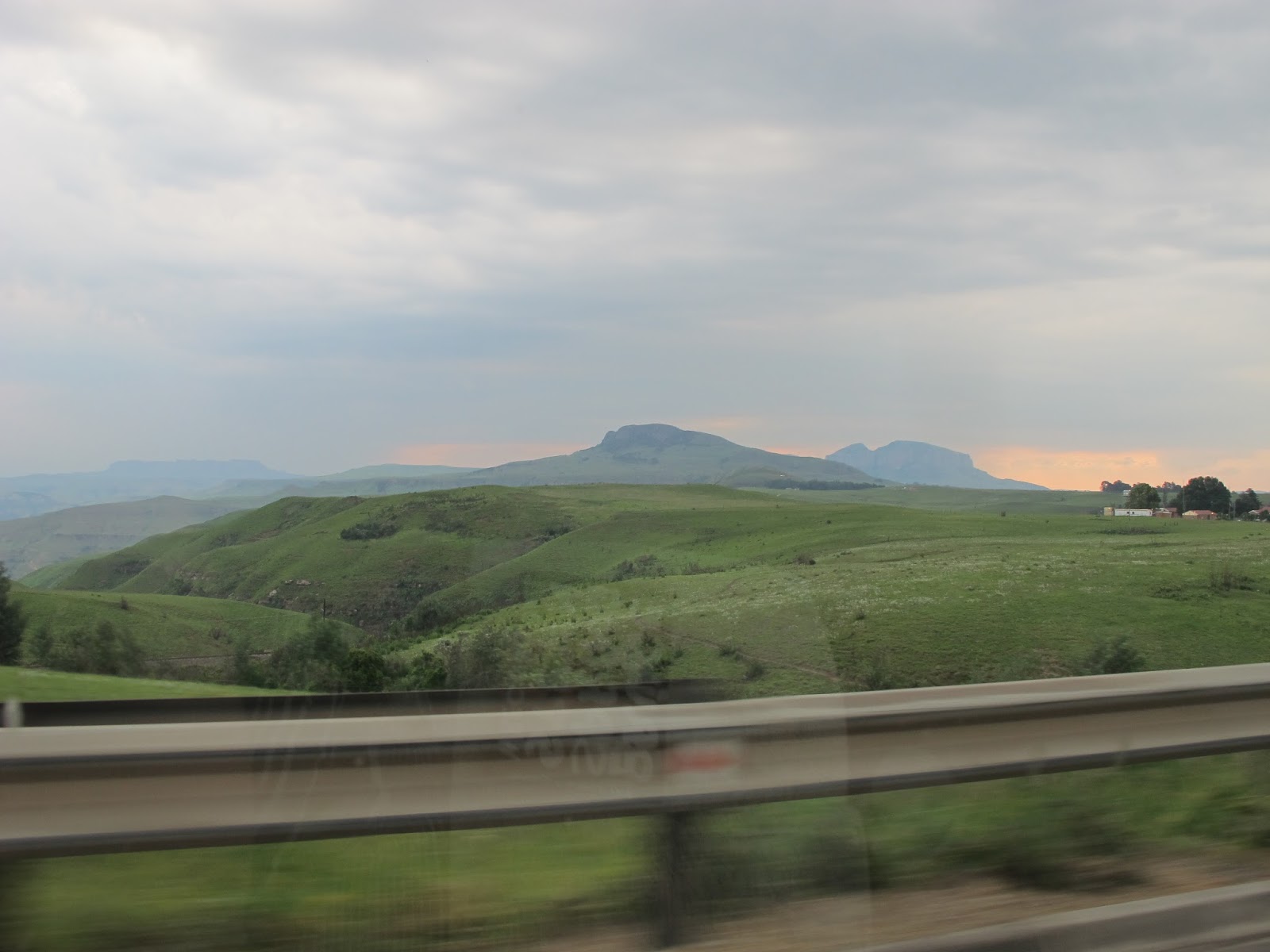
 As we exited this never-ending typically straight Free State road we eventually started to climb through the hills crossing over into the Zulu Battlefields. There is a spectacular  mountain pass here called van Reenand's Pass which has incredible views over impressive empty mountainside. On the road down to Durban there are precious few convenient places to stop and get out to admire the view, although on the way back up to Joburg there are a number of stop-off places touting for tourism, such as 'the World's Smallest Church'.


It's worth adding that the weather on this section of the road does whatever the hell it wants. It can be be foggy, raining heavily, and throwing huge gusts of wind all at the same time. There are usually a lot of trucks trying to chug their way up and down the hills and the road meanders a fair deal, so it pays to drive carefully and obey the speed limit signs (the limit can drop to 80km p.h for cars on particularly steep stretches).  That said, the N3 is much like all of South Africa's main highways - in darn good nick. If you want to drive a really treacherous and hellish main highway try (as we once did - from the old blog, parts 1, 2 and 3 here, here and here) the Rossiya highway between Moscow and St. Petersburg...After doing that, everything else is a piece of cake.

It's only a another hour or two after the pass where you hit the turn offs for the 'Meander'. The Meander is a series of back-road routes through various farms, craft outlets and small villages between the small towns of Mooi River and Howick. The area is a popular place with tourists looking to shop for top quality handcrafted stuff and real farm-to-plate foodie goods and also runs a huge trade in weddings.

Shopping in the Midlands Meander


Our home for two nights in the Midlands was the aptly named Pleasant Places. This is a gorgeous old farm turned guesthouse nestled in a quiet valley. In the morning we gazed out over the bright green hilly fields of the large working farm across the river and enjoyed what my husband believes to have been his best breakfast ever, before returning to our lovely antique filled room for a brief nap. We then, almost reluctantly left the Pleasant Place to see what the Meander had to offer.

First along the way, with nothing in mind other than to visit any place that took our fancy, we stopped at a leather factory called Born In Africa. Here local people hand make handbags and shoes with genuine leather uppers. I bought probably the most comfortable pair of leather wedge sandals I have ever owned in my life. And they cost just R300. I should have bought 3 pairs!

We then made a detour off the tarred road and up a rocky dirt track to reach a place atop a hill with a name that I just couldn't resist - the Swissland Cheese Farm. This was an idyllic spot for a lovely relaxed lunch. We bought a few slabs of incredibly moreish goats cheese from the farm shop and a little bottle of wine and set ourselves up on the grassy lawn overlooking yet another lonely farm in a picturesque valley.


Onwards our foodie meander went into the little town of Nottingham Road. If you know your South African craft beers then you may have heard of Notties. It's a fine craft brewery based in Nottingham Road and they have a nice Austrian chalet themed pub down there too. Unfortunately there was a rowdy bunch of youngsters on a post-wedding binge who'd rocked up to obliterate themselves on the fine booze at the same time that we had come to sample the brews. I may have just taken it in my stride had it not been that we'd chosen to stick around to watch another humiliating Spurs defeat in the bar at the same time. Ah, Spurs, there's so much more to say about my team, but alas, back to the holiday! The gang eventually left in a blur of swaying bodies and embarrassed girlfriends and we set in to some outlandishly sized Germanic specialties including the famous Eisbein. Nyom.

Next morning we were up and at 'em relatively early and prepared to drive our second leg of the journey down to Margate on the Hibiscus Coast. Before leaving the Meander we made a stop off at a large collection of lovely farm and craft shops and rustic restaurants called Piggly Wiggly. We had been tipped off about the place at the guesthouse and my husband was desperate to buy some ridiculously hot chili relish which he'd had with his breakfast. He bought two bottles, one labelled Rattlesnake Bite and another, the ultimate in blow-your-head of ludicrous heat, called Lord of the Ring. This is serious teaspoon at a time stuff in case you hadn't already guessed from the names.

We also considered making a detour to one of the country's best coffee roasters Terbodore Coffee, but decided instead to hit it up on the way back. It was definitely worth getting to and we only sorely regret that we hadn't made an advance booking for the attached restaurant as the food looked (and smelled) divine.

The other place which I insisted on stopping by before getting back on the highway was the Howick Mandela Memorial which is only about 6km from the N3 Howick turn-off. It was here that back in the 1960s Nelson Mandela, then the country's most wanted man, was captured by the Apartheid police. The moments before his capture were to be his last as a free man for 27 years. There's an impressive monument here as well as a visitor centre containing an extensive exhibition on the life of Mr Mandela. As we were there on the day that Mandela was buried in his home town of Qunu, there were a particularly large number of people around who had come to leave flowers and teach their children about Madiba and his message of reconciliation, social justice and human dignity.

Piggly Wiggly farm shop

Flowers and candles for Mandela in Howick
Unfortunately it was raining buckets so I didn't photograph the actual Memorial itself. However, I just had to snap this poster in the visitor centre.


Back on the road: Howick to Margate


Back on the highway we passed out of the very English looking landscape of the Midlands and into the romantically named Valley of a Thousand Hills. This is true Zulu country and the hillsides are dotted all over with little one room homesteads painted in bright colours clinging to steep red soiled slopes. With the ocean now in sight we skirted around the fringes of Durban and out onto the N2 which hugs the coast for around 150kms, before swerving inland through the interior of the Eastern Cape.


Much of the coastal road around Durban is surrounded by poor townships which spread across both sides of the highway. This means that for much of the way there are people walking along the side of the busy road or dashing across the lanes to reach shops or homes on the other side. It's a pretty hectic driving environment and also one that dramatically highlights the shockingly vast differences in wealth in this country. Here the BMWs and Mercs race past at 150kph hurrying to get to their lush luxury holiday resorts whilst young black men and women walk for kilometres beside the road lugging shopping bags to their homes in atrociously serviced villages and towns. I want to say that this experience was 'eye-opening', but sadly I have now been here long enough to see it as yet another reminder of the harsh reality of life here.

Around about an hour after passing Durban we finally reached the Hibiscus Coast, a lush tropical section of the KZN coastline lined by long stretches of surf-basked white beaches. This area would be our home for the week. You can read more about this haven of golf and surf in my next post.

----------------------------------------------------------------------------------------------------------------------------------

Drive time (with stops for coffee and snacks): 
- Johannesburg (Illovo) - Lidgetton Valley, Midlands, KZN = approx 5hrs, 465km
- Lidgetton Valley, Midlands, KZN to Margate, Hibiscus Coast, KZN = approx 3hours, 255km


5 Great shops in the Midlands Meander:

SwisslandCheese Farm, Balgowan, 4Kms off R103
Born in Africa (shoes), Old Balgowan Farm, R103
NottinghamRoad Brewery, Nottingham Road
PigglyWiggly Country Village, R103, 10km from Howick off ramp

And one really great Midlands Guesthouse:

PleasantPlaces, Lidgeton Valley

For more on the Midlands Meander visit www.midlandsmeander.co.za

Monday, 9 December 2013

How we remember Mandela

It had been on everyone's mind for while. We'd all had a big scare a few months ago when he spent weeks critically ill in hospital. Finally on Thursday evening, December 5th December, Nelson Mandela, commonly referred to here in South Africa as 'the Father of the nation', died at the age of 95.


People always like to tell the story of where they were when big historical moments happen. I vaguely remember the fall of the Berlin Wall. My Dad was watching people singing and hugging, chugging sledgehammers and helping each other clamber across a graffitied wall on TV. And he was crying. I was still only 8 years old and was confused and fascinated. 'Dad. Why are they crying? Why are you crying?!'. 'Because they are happy. Look at these people, this happiness! This is a wonderful moment. You must remember this.' He was at pains to make sure I remembered that moment, and I still vaguely do, although it actually took me many, many years before I truly understood what it had meant. I remember well when Lady Di died. My radio alarm clock was playing the news. I was sure I had dreamt it. Britain changed that day. Not because of the person that was gone, but because of the way we reacted. It was pure public grief and collective mourning. We didn't used to do that kind of thing in Britain. Now we do. And I'll always remember seeing 9/11 happen in front of my eyes. I had a week left before I went for my first year of university. I was still at home already getting into the student lifestyle - watching the lunchtime episode of the soap opera Neighbours. I stayed up past midnight and cried gutting tears of despair and shock before I fell asleep and then got up to glue myself to the news for another day. It was unbelievable. But we all watched it happen, live on TV.


As for this (much more expected) moment, I was at home brushing my teeth. It was almost midnight when President Zuma went on the air to address the nation. The only reason I didn't just finish brushing my teeth and go to bed was that my husband (a news wire journalist) had just said to me; 'I will not be surprised if we wake up tomorrow and Mandela has died...'. He said he was getting a lot of messages on his phone about family members arriving at the Mandela house in Johannesburg. Something was up. I immediately turned to Twitter and literally within half a minute there it was, the President had appeared on TV and was telling us of Mandela's death. This is how far we have come with technology. Things can be confirmed within seconds and news spreads faster than lightning through the chatter of online social networks. We stayed up until 3am watching the news and fell asleep for four hours before my husband rushed off to work. On our way to his office (I was stark awake and wanted breakfast, I'd get to my own job afterwards) the radio announced the news. Most South Africans had long been asleep when Zuma went on TV and this was the first they had heard of it. They played beautiful old South African songs including a 1980s anti-apartheid classic Asmibonanga. I couldn't help but shed some tears.

Click here if video is not working:
http://www.youtube.com/watch?v=V3LLcikA8-M

I have mentioned many dramatic and traumatic events which most believed they would never see. This is not one of them. Nelson Mandela was a 95 year old man. Quite frankly for anyone, that is grand age; nevermind somebody who lived a life such as he did. However, the way that the nation would feel, the emotions that the average South African would grapple with and how they would choose to react, I think was still something that many in this country were unsure of. Just as after a very long life, you lose a beloved grandparent - that elder of the family who holds everyone together - you never can quite know how you will feel when they finally pass on. Sometimes when people consistently fight on through old age, for the younger it can feel as if they will always be amongst us. Alas, deep down we all know the day will come. This week, for South Africa, it was Tata Madiba's day to finally pass away and leave us to be with his ancestors.

The places of remembrance


The people of Johannesburg quickly chose their own places to pay their respects. Nelson Mandela Square in the country's richest business district Sandton quickly became a place for people to lay flowers and sign a book of condolence. People arrived in the street in front of his home in the leafy suburb of Houghton to sing and lay flowers literally minutes after the announcement. Ever since, all kinds of people, but especially families, have been arriving at the street of Mandela's home to pay their respects and celebrate his life. Vilakazi, the street in Soweto where he once lived in the days before he was a prisoner on Robben Island, filled with people within hours of the announcement and they are still there now. And at various other places across the city, impromptu memorials kept appearing. We went to Liliesleaf in Rivonia (where Mandela and his comrades laid the plans for an armed struggle against apartheid which landed them in prison for life). Local school children sang songs and people laid flowers, whilst excitedly sharing their memories of 'that time Mr Mandela shook my hand' (there's not one person I know who has met Mandela and was not almost immediately charmed).


At no point did we see people crying. In fact it was the reverse. People were smiling, shaking hands, singing and dancing! The overwhelming feeling over these last days (for me) has been that South Africans have been given a moment to reflect on and appreciate what they now have, as a result of the work and struggle of people like Nelson Mandela. Mandela's death is a positive moment of celebration for this country, to have had such a wonderful leader and to have achieved such hard-fought freedom. This is now a democratic and free country with the most progressive constitution on the planet. All people, in principle, have equal rights. The government is directly accountable to all the people and the people have the right to protest, to complain and to speak their mind, no matter their opinions. I cannot begin to explain quite how phenomenal the South African constitution is. Mr Mandela did not achieve this alone, but with grace, charisma, wisdom and integrity he helped to make that dream a reality.


I want to be clear here - I love  this country. This is an incredible place with some amazing people. But in no way am I trying to say that South Africa is a perfect. South Africa is a country with many deep and difficult problems. There is a vast and crushing disparity between the rich and the poor. The (predominantly black) poor are deeply disenfranchised and live on the peripheries of society in some of the worst conditions you will find anywhere on our earth. There is corruption. Real corruption of the kind that makes those who hoped for a better country wonder if they really got one. There is crime - but please, this is not Gotham City! - but yes, there is still crime, it is not as bad as it once was, but it does not go away.

And, there is the tragedy of xenophobia. The many who continue to arrive here from war-torn and despot countries such as Zimbabwe and Congo with dreams of a better life and opportunities to put food on the table, face real and often violent xenophobia. They talk of hopeless lives back home, but also talk of the fear of revealing their identity to South Africans, the fear of violence and the longing for the possibility to return home - if only to escape the discrimination of those here that they thought of as fellow, sympathetic black Africans.

The Day of Prayers and Reflection


On Sunday we went in search of a church to visit for the 'Day of prayers and reflection'. We were hunting for somewhere where we would find young people and possibly those from other parts of the continent. After a roundabout tour of Braamfontein (the student neighbourhood next to the university) we were eventually drawn in by some loud spiritual music to what seemed to be an old shop in the shadow of the Nelson Mandela Bridge. I have to admit, there were a lot of strange things going on during the service. I'm not a religious person anyway but I've been to church a fair few times (my husband's a Christian) and this wasn't anything like going with my Grandma to the local church of England! To sum it up, it was a kind of a cross between intense bible study and very emotional motivational speaking.

Turns out (we only understood this much later), this was a local branch of a well-known Nigerian evangelical church which is led by a charismatic pastor with his own TV channel. There were moments of quite claustrophobic spiritual euphoria (mass shaking hands and bodies, rapid muttering of prayers, shouts of 'PrAise de Lord!' and general loud preaching about the 'Grace of God') but mostly the service was all about how can you take what Jesus said and learn from it to make yourself a better person in this world. Everyone had their own bible and highlighters with them and were making notes. For me, this was a long service, but it was also a valuable and totally unique cultural experience. On any other day I would probably have never gone in there!

In respect of the 'Day of prayers and reflection' the Pastor, had asked the youngest members of the congregation to speak about Nelson Mandela and his ideals (rather than tailoring his sermon to a Mandela story). The eldest of them, a very beautiful and vibrant student, passionately spoke directly to her peers, listing their responsibilities to themselves and each other. The overriding message was education (both gospel and formal academic). The Pastor picked up on this and until the end (almost three hours!) the theme of the service was education (academic, moral and of course mostly gospel/spiritual).


Learning from the legacy


Which leads me to the end of my thoughts on the last few days. We keep talking here in South Africa about 'what can we learn from Madiba's legacy?'. Considering he has been around a while you would think people have learned a lot already. But, in the wake of his death everyone is now questioning themselves anew; 'What is this modern South Africa? How did we get here? Where are we going? Do the people in power do anything to make this place what I want it to be? What do I want it to be?!'.

For me the legacy, the questions, and the future, all lie in education. I am an outsider, and I have been living here for less than a year, but I have seen and heard already enough to know that state education in this country does not live up to the standards that it should. Many working-class South Africans with decent wages would still rather live in a slum so that they can save their extra money to put their child through private education, when state education is universal. This should not be. Education is a right in this country, but decent education is not. It should not be that almost the only way to reach the professional classes is through paying for a private education. The ability to shape this country should be more accessible to all.


Nelson Mandela helped to create a country where race was no longer a determining factor in the fate and dignity of a human being. He helped build a proud nation made up of people of many races and religions who could forgive the indignities and cruelties they paid to one another. He did not so much as see a child for 27 years whilst he was in prison and yet upon his release and throughout his final years the people he had the most time for where children. The minister or the child - he would greet the child first.

The children of this world are those responsible for building the better world of the future which we dream of. The decent education of all children is how we make a legacy.